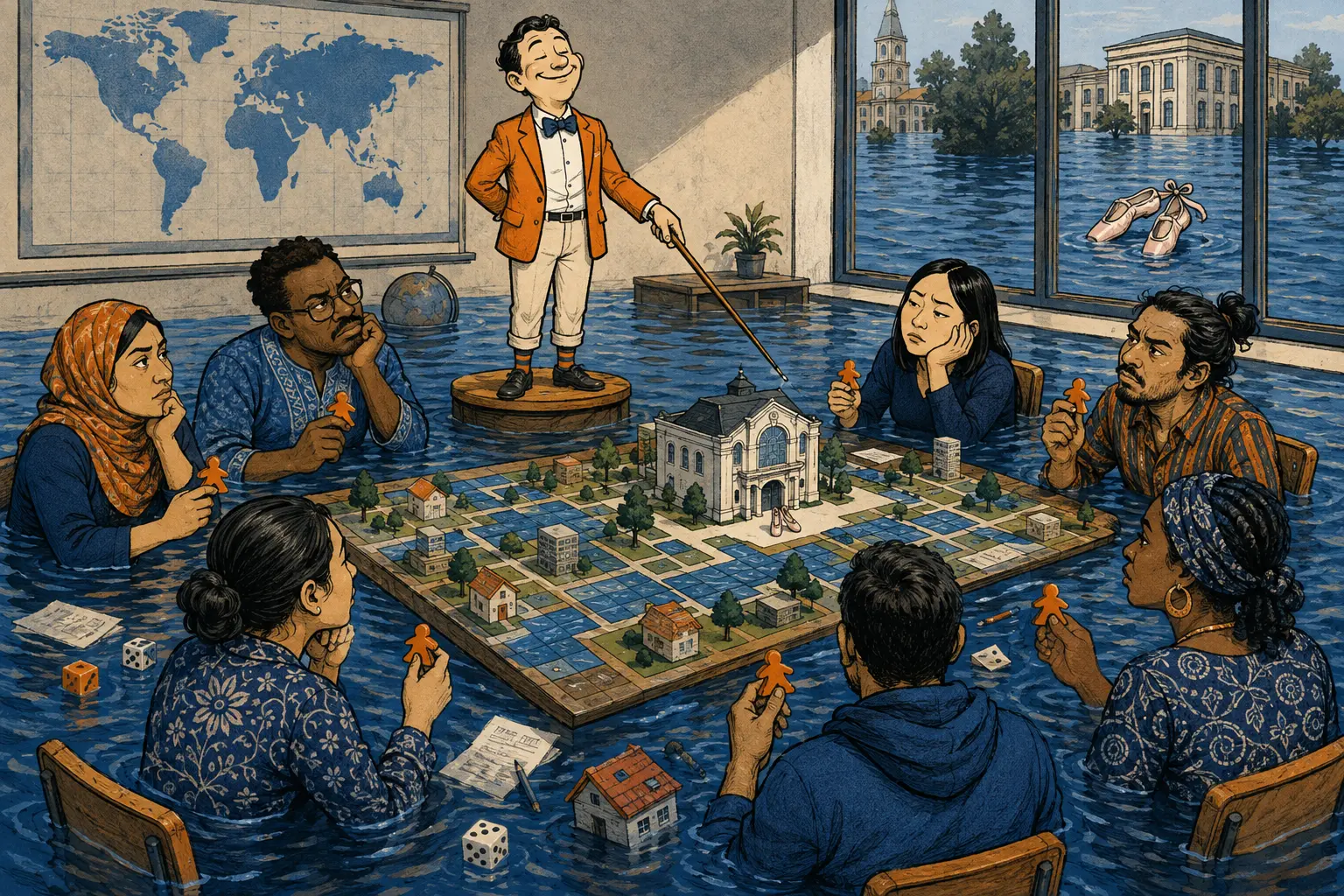

The flood came at the end of the round.
Until then, I had been making the kinds of decisions the game expected from me: where to live, how much to spend, whether to invest in protection, how much risk to tolerate. Around the table, other students were doing the same. We had different budgets, different houses and different levels of exposure. Then the dice decided whether the water would come.
This was WhereWeMove, a serious game developed to explore how people make housing and adaptation decisions under flood risk. Players take the role of homeowners facing repeated flood risk and make choices about housing, relocation and protective measures under financial constraints and changing conditions.
And that is precisely what makes serious games useful.
It is also what makes them worth questioning.
Because while we were all playing inside the same simulated world, we had not arrived from the same real one.
Our classroom was international. I began to wonder whether the world we were playing was international too.
A student raised in the Netherlands may have grown up in a country where flood protection is deeply institutionalised and where public institutions play an unusually visible role in keeping water out. Another student may come from a place where protection is experienced more as an individual, household or family responsibility. Someone may regard insurance as an ordinary part of owning a home. Someone else may have grown up where insurance is inaccessible, distrusted or simply absent.
Give those students identical houses, identical incomes and identical choices on a game board and they are still not identical players.
They bring their worlds with them.
The player underneath the player
This problem is not unique to WhereWeMove. It sits at the heart of what serious games try to do.
To make reality playable, complexity has to disappear.
WhereWeMove already represents more than simple risk and money. Research around the game examines financial capacity, risk perception, previous flood experience and trust in public protection. Its decision framework also includes responsibility or ownership appraisal: whether a player sees protective action as their responsibility or places that responsibility elsewhere. Players can adopt measures, relocate, pursue satisfaction-enhancing choices or rely on public protection.
Those are meaningful distinctions. They also make the next question more interesting.
How much of a player's interpretation of wealth, risk, responsibility and trust comes from a world that existed before the game?
If my house is at risk of flooding, whose responsibility is it to protect it? Mine? My insurer's? My municipality's? The national government's? My community's?
There is no context-free answer to that question. When a game asks whether I will spend money protecting my house, my answer may contain more than my assigned wealth or stated risk perception. It may also contain experience with institutions, property, inequality and collective responsibility.
What looks like an individual decision inside the game may therefore have a history outside it.
Which building do you save first?
Now imagine a different decision. A flood is moving toward a city. You have limited time, limited emergency resources and a limited budget. You cannot protect every building equally. You have to decide where temporary barriers should go, where warnings should be prioritised and which places should receive scarce resources first.
On the map are homes, shops, a school, a church and a building used for dance classes.
Which one do you protect first?
The answer may look technical. Count the people exposed. Estimate economic losses. Compare vulnerability. Rank the buildings by risk.
Then put the same decision in an international classroom.
Ask a Muslim student how much priority the church should receive. Ask someone who has never danced whether the dance centre is worth protecting. Put beside them someone for whom that church represents family, community and belonging, or someone who has spent twenty years dancing in that building.
Give all of them the same budget, the same flood map and the same information.
Have you really given them the same decision?
Their backgrounds do not tell us what they will choose. The Muslim student may protect the church first because it matters to the wider community. The non-dancer may fight hardest for the dance centre because hundreds of people depend on it.
That is precisely the point.
The interesting question is not whether identity predicts the decision. It is whether we can understand the experiences through which that decision was made.
A game may record something much simpler: Player A prioritised the church. Player B prioritised the school. Player C prioritised the dance centre.
Those choices are observable. The worlds behind them are not.
Serious games necessarily simplify the city. But the people playing them arrive carrying cities of their own.
A simulated world produces behaviour too
There is another complication.
A serious game does not merely observe behaviour. It creates the world in which that behaviour becomes possible.
WhereWeMove defines the residential options, public protection levels, financial conditions, protective measures, flood events and consequences through which players make decisions. Research using the game shows how strongly those settings matter: affordability can constrain action even when perceived risk is high, and changes in relocation rules, public protection, measure costs, housing availability and information can alter observable behaviour.
That distinction matters.
If relocation is available, moving becomes thinkable. If insurance is available, risk can be transferred. If household decisions are represented through income, savings, mortgage capacity and protective investments, an institutional picture of housing has already entered the room before the first choice is made.
None of this makes the game wrong.
It makes the game situated.
One WhereWeMove-based agent model makes this contextual point especially visible: it studies adaptation in a Western European setting characterised by strong public flood protection and high institutional trust. Another study based on the game explicitly warns that its findings cannot simply be generalised to other countries or populations.
Every simulation has to draw boundaries around reality. The important question is whether we remain aware of those boundaries when we interpret what players do inside them.
The classroom may know something the game doesn't
There is an irony here.
Universities often celebrate the international classroom precisely because students bring different perspectives. We put people from different countries around the same table because we expect those differences to produce better conversations.
Then we sometimes design learning exercises in which those differences become noise.
Perhaps we should do the opposite.
Before a serious game begins, ask players where they locate responsibility. After it ends, ask whether they played according to their assigned character, according to themselves, or somewhere in between. Ask why two people facing the same simulated conditions made different choices. Ask whether concepts such as homeowner, safety, satisfaction, responsibility or even risk meant the same thing to everyone around the table.
This is not an argument that nationality or culture mechanically determines behaviour. The WhereWeMove studies reviewed here do not establish that. It is an argument for treating the player's background as a possible source of interpretation rather than assuming that everything relevant begins when the game starts.
The differences would no longer be inconveniences to control away. They could become part of what the game teaches us.
Because an international classroom offers something extraordinarily difficult to simulate: people carrying different institutional, cultural and personal histories into the same room.
A serious game can give us the same rules.
It cannot give us the same past.
And maybe it shouldn't try.
Research basis
- Thomas Rehder, Juliette Cortes-Arevalo, and Geertje Bekebrede. Key Factors for Using Games Such as WhereWeMove in Municipal Flood Risk Communication and Collaboration. In Shaping the Future through Simulation and Gaming, edited by Friedrich Trautwein, Birgit Zürn, Heide Lukosch, Sebastiaan Meijer, and Tobias Alf, Lecture Notes in Computer Science 16439, pp. 264–279. Springer Nature Switzerland, 2026. https://doi.org/10.1007/978-3-032-20129-4_18.
Editorial note. The church/dance-class scenario is a thought experiment introduced by Elseground; it is not a scenario from WhereWeMove. The research cited above does not establish that nationality, religion or culture determines player behaviour. The essay uses the game as a starting point to ask how institutional, cultural and personal histories might matter when serious-game behaviour is interpreted.
Reader responses
Leave a response.
Every comment is reviewed before publication.