
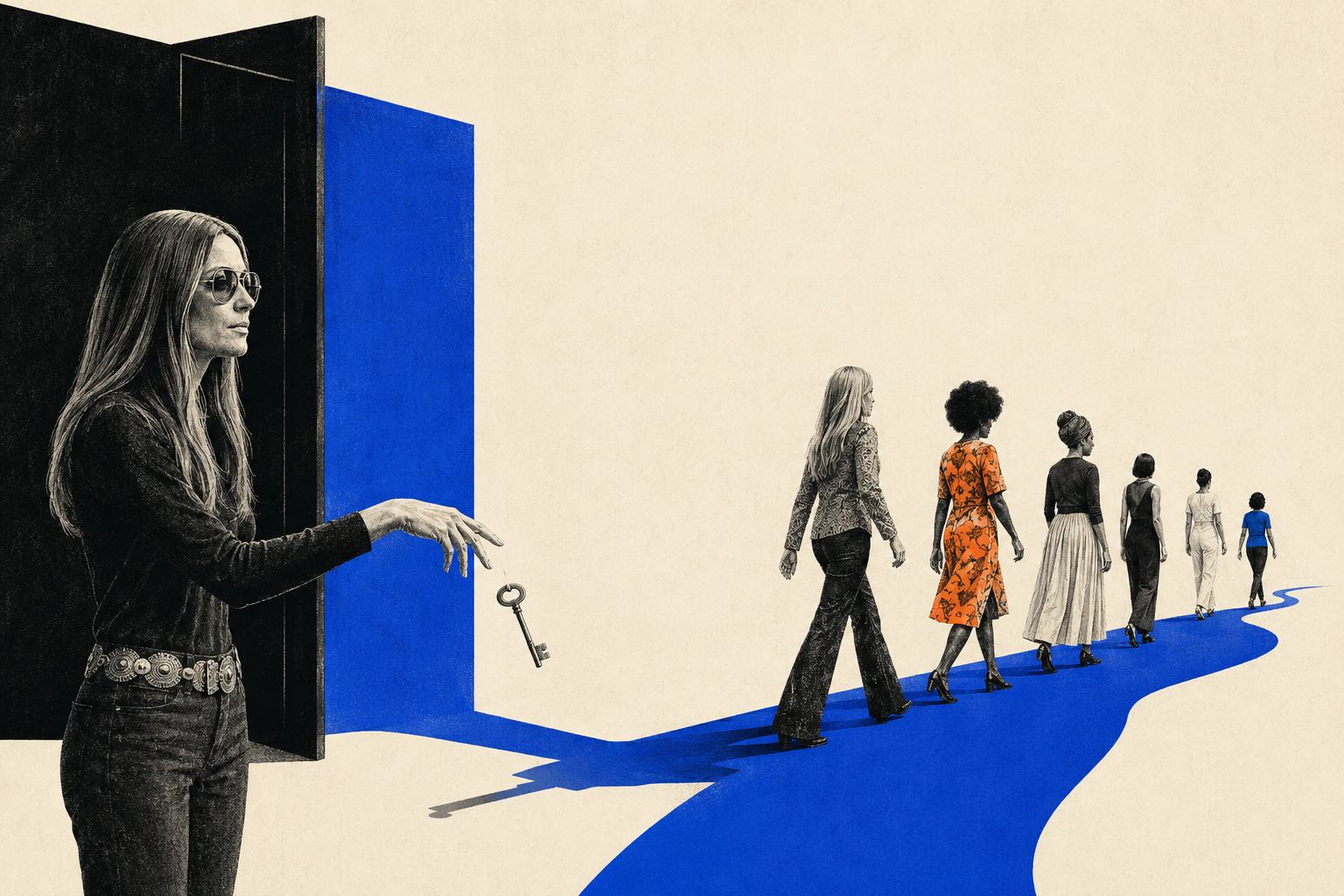
Gloria Steinem helped open doors that had been closed to women. Honouring her work does not require us to stop asking who built those doors, who remained outside and why anyone had the authority to hold the key.
Gloria Steinem died this week at the age of ninety-two. The news produced the language that often follows the death of a movement figure: pioneer, icon, trailblazer, legend. Beneath those words was another, quieter expectation gratitude.
We are supposed to thank the people who came first. Thank them for entering rooms from which people like them had previously been excluded. Thank them for speaking when silence was safer. Thank them for making our own arrival less improbable.
And we should.
But gratitude is complicated whenever it meets power.
I can be grateful for the door you opened and still ask why you were the one holding the key.
That sentence is not about Steinem alone. It is about the bargain hidden inside many opportunities. Someone offers us entry to a workplace, a university, a country, a publication or a political movement and the invitation arrives with an unwritten condition: appreciate what you have been given, and do not examine too closely the system that made you ask for permission.
The door opens. We step through. Then we learn that admission is not the same as belonging.
01THE WOMAN INSIDE THE COSTUME
Before Gloria Steinem became one of the most recognisable figures of American feminism, she entered the New York Playboy Club wearing a satin costume, high heels and a pair of rabbit ears.
It was 1963. She was twenty-eight, a freelance journalist trying to establish herself in an industry where men controlled most serious assignments. To investigate the club, she applied for work under a false name and spent eleven days as a Playboy Bunny.
The resulting investigation, later known as A Bunny’s Tale, described the workplace concealed beneath the fantasy: exhausting hours, surveillance, sexual demands disguised as entertainment and a system of fines and deductions that reduced the women’s earnings.
The club sold an image of female freedom. Steinem looked at the women doing the labour.
That distinction would shape much of her public life. The question was rarely only whether women could enter a room. It was what happened to them once they were inside. Who established the conditions? Who benefited from their presence? What did they have to wear, tolerate or become in exchange for admission?
Playboy gave Steinem access of a kind. She used that access to expose the institution rather than praise it. She did not confuse an opened door with a fair room.
Years later, she helped create new doors. She co-founded Ms. magazine, which placed subjects treated as private or insignificant—abortion, domestic violence, childcare, sexual harassment and unequal work—inside a serious political publication.
She also helped establish organisations intended to increase women’s participation in politics and public life. Her work made it easier for many women to imagine themselves not as guests in public debate but as authors of it.
That deserves gratitude.
It also raises a harder question: what happens when the person who once challenged the gate becomes associated with the gate herself?
02WHEN GRATITUDE BECOMES A DEBT
Gratitude begins as an emotion. It can be intimate, sincere and freely given. Someone recognised our ability. Someone took a risk on us. Someone made space at a table that had never expected our presence.
But institutions often transform that emotion into a debt.
The first woman promoted to leadership is expected to appreciate the opportunity rather than discuss the sexism she still encounters.
The migrant who finds safety is told that criticising the host country is an act of disloyalty.
The scholarship student is encouraged to become a success story but not to describe the loneliness, class difference or humiliation inside the institution.
The young writer published by a prestigious editor learns that raising concerns may be interpreted as personal betrayal.
“You should be grateful” rarely means only “recognise the help you received.”
It often means: do not make the person who helped you uncomfortable.
Do not ask why your future depended on their approval. Do not mention those they did not choose. Do not examine the criteria by which you were judged. Do not ask whether the door was opened because the institution changed or because you learned how to appear acceptable to it.
This is where gratitude stops being a feeling and becomes a form of discipline.
The person admitted is expected to demonstrate that the gatekeeper made a good decision. She must be talented but not threatening, different but not disruptive, honest but not ungracious.
Her presence is celebrated as evidence of progress, while her criticism is treated as evidence that she did not deserve the opportunity after all.
The door is open, but the key remains visible.
03WHO GETS REMEMBERED AS THE OPENER?
Remembering Steinem also requires us to question how history distributes recognition.
She became a public symbol of American feminism partly because she was articulate, persistent and strategically gifted. But visibility is never produced by merit alone. It is also shaped by race, class, beauty, education, media access and the public’s idea of who appears credible.
Steinem worked alongside a much larger and more diverse movement. Black feminists, labour organisers, queer activists, Indigenous women and working-class campaigners were not standing behind one famous woman waiting to be liberated.
They were developing their own analyses and organising their own struggles sometimes while challenging the exclusions of mainstream feminism itself.
Figures such as bell hooks, Audre Lorde, Angela Davis, Pauli Murray, Dorothy Height and Dolores Huerta showed that gender could not be separated neatly from race, labour, sexuality and economic power.
The members of the Combahee River Collective went further, explaining how different forms of oppression could operate together rather than as separate problems.
Some women did not simply need access to the rooms occupied by privileged men and women. They needed the building to be redesigned.
To recognise this is not to diminish Steinem. It is to resist turning collective history into the biography of its most visible representative.
A movement is not a door opened by one heroic hand. It is pressure accumulated over years: bodies against hinges, voices outside windows and people building other entrances when the official one remains closed.
Sometimes the person remembered for opening the door is simply the person the cameras could see.
04THE GRATEFUL GENERATION
Every generation inherits opportunities created by people before it. It also inherits the limitations of their imagination.
That is why younger feminists can be grateful to Steinem and still question parts of the movement with which she was associated.
They can honour the battles fought over reproductive rights, political representation and workplace discrimination while asking why some experiences received more attention than others.
They can inherit the language of equality and extend it to people who remained at the edges of earlier conversations.
This is not ingratitude. It is how living movements remain alive.
If admiration requires agreement, it becomes worship. If gratitude requires silence, it becomes obedience. And if the only acceptable way to honour a pioneer is to preserve her conclusions untouched, then the door she opened leads only into another closed room.
The better tribute is continuation with scrutiny.
Steinem’s political significance did not come from politely inhabiting the world she was offered. It came from looking at ordinary arrangements (magazines, offices, marriages and political organisations) and asking why they had been designed in that particular way.
Applying the same method to her legacy is not a rejection of it. It is participation in it.
05THE KINDNESS OF THE GATEKEEPER
None of this means that every person holding a key is cruel.
That is what makes gatekeeping difficult to recognise. It often arrives through kindness.
A professor recommends one student. An editor gives an unknown writer a chance. A manager supports a woman’s promotion. A citizen helps a newcomer navigate an unfamiliar country.
These acts matter. Lives can change because one person decided to say yes.
But a kind gatekeeper is still a gatekeeper.
The moral character of the person making the decision does not resolve the deeper question of why access depends so heavily on individual favour. A benevolent system of permission remains a system of permission.
We should be able to say two things at once:
You helped me, and I will remember it.
You should not have possessed so much power over whether I could begin.
These statements are not contradictory. The first recognises a relationship; the second examines a structure. One belongs to gratitude, the other to justice.
Confusing them protects institutions from criticism. It makes every demand for reform sound like a personal insult to the people who behaved decently within an unequal arrangement.
But structural criticism does not require us to deny individual goodness. It asks whether a fair society should have to rely on goodness being available at exactly the right moment.
A door should not open only when the right person happens to be holding its key.
06AFTER THE DOOR
The goal is not to replace one group of gatekeepers with another. It is not enough for women, migrants or formerly excluded people to acquire keys and reproduce the same rituals of permission.
Representation matters because decisions change when different lives are present. But representation becomes shallow when the structure itself remains untouched when a new face appears at the entrance while the same private rules continue to determine who may enter.
Real change asks more demanding questions.
Can the criteria for admission be made transparent?
Can people challenge decisions without risking exile?
Can opportunities become rights rather than favours?
Can those who enter participate in changing the room?
Can the institution hear criticism without demanding a performance of gratitude first?
Most importantly: can the person who opens a door be willing to surrender the key?
That may be the deeper measure of solidarity. Not simply helping selected individuals cross a boundary, but reducing the power of that boundary over everyone else.
A mentor can recommend a young woman and then challenge the informal network that made the recommendation necessary.
An editor can publish a marginalised writer and then reconsider who defines literary authority.
A university can admit first-generation students and then examine the culture that makes them feel like visitors.
A country can offer safety without demanding political silence in return.
Opening the door is a beginning. Justice concerns what happens to the lock.
07GRATITUDE WITHOUT SURRENDER
When a public figure dies, criticism can feel indecent. Death seems to ask for clean conclusions: hero or failure, gratitude or rejection, celebration or indictment.
But a serious legacy should be able to withstand complexity.
Gloria Steinem helped alter who could speak publicly and what could be spoken about. She entered institutions, exposed their arrangements and helped build platforms where women could describe their lives politically.
The opportunities available to many women today did not appear naturally. They were made more imaginable by struggles in which she played an important part.
We can acknowledge all of that without pretending the work was complete.
We can honour a woman without reducing feminism to one woman.
We can recognise an opened door while remembering everyone still waiting outside it.
Perhaps mature gratitude is not silence but responsibility.
It says: I know this passage was made easier by those who came before me. I will not erase their labour. But I will also not treat the limits of their achievement as the limits of what is possible.
Thank you for opening the door.
Now let us ask who built it, whose body was used to keep it shut, why entry required permission—and whether the next generation should have to knock at all.
08IN MEMORY OF GLORIA STEINEM.

Reader responses
Leave a response.
Every comment is reviewed before publication.