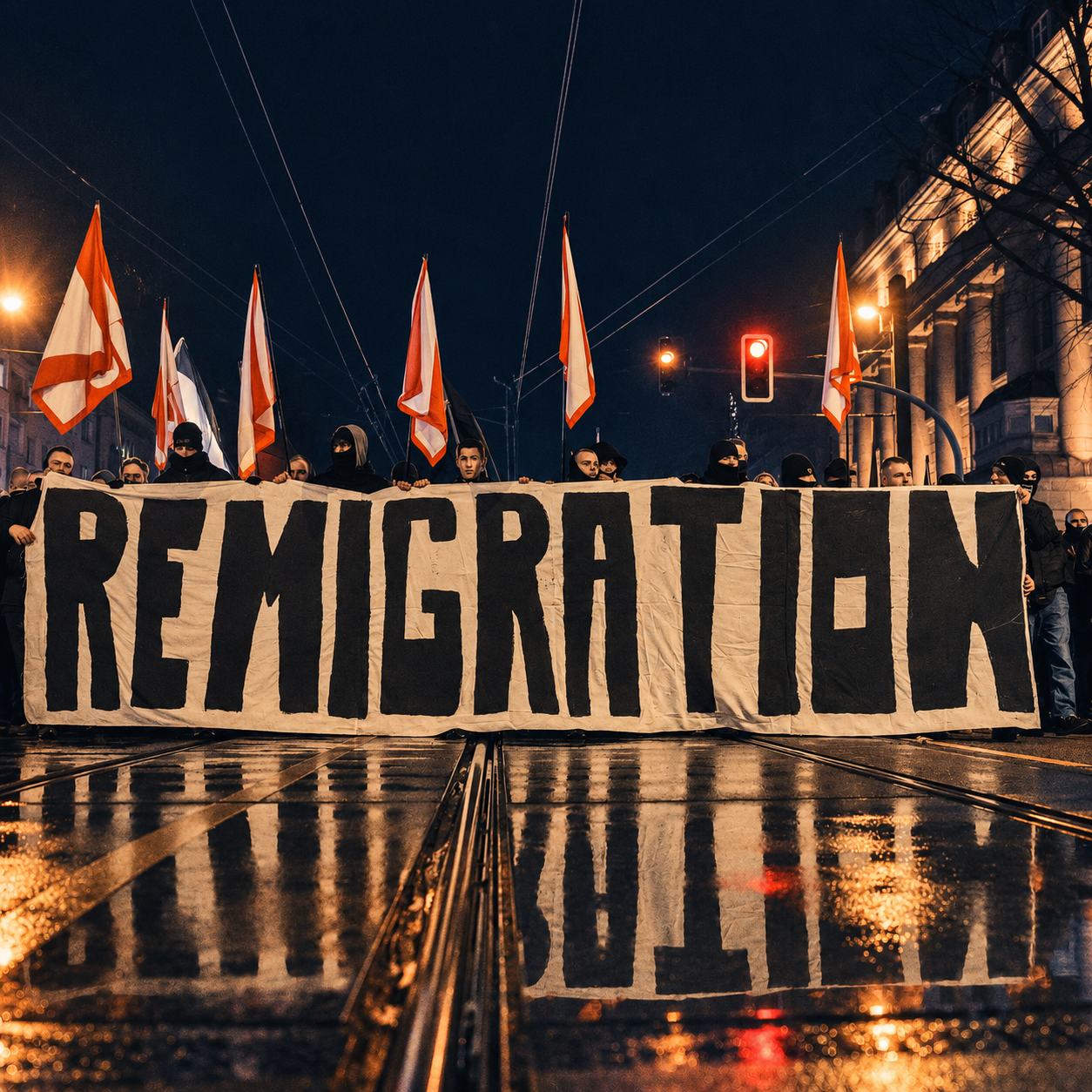

“Remigration” once described people moving back. Now it increasingly describes a political project for deciding who should.
There is something almost peaceful about the word remigration. Migration. Remigration. Going somewhere. Going back. It sounds cyclical rather than violent. Almost natural. Birds migrate. People migrate. Sometimes they return.
And for much of its history, that was approximately what the word meant. Long before it appeared on political banners or in election programmes, remigration belonged to a very different vocabulary. Its roots reach back to the Latin remigrare: to move back, to return. Later, researchers studying migration used related terminology to describe people returning to countries they had previously left.
Nothing especially sinister was hidden inside it. A migrant leaves. A migrant returns. Perhaps the migrant leaves again. Migration scholars still study exactly these movements: return, reintegration, circular migration and re-migration.
But something happened to the word. The person performing the action slowly disappeared. And the state entered the sentence.
First, the migrant remigrated
Language contains politics even when it looks like grammar.
Consider these two sentences:
A migrant remigrated to their country of origin.
And:
The government will implement remigration.
They contain almost the same word. They describe radically different worlds.
In the first sentence, the migrant is the subject. The person moves. Perhaps they missed their family. Perhaps they found work. Perhaps their asylum claim failed. Perhaps conditions improved at home. Perhaps conditions became unbearable abroad.
Whatever the reason, migration is being described as something happening in a person's life.
In the second sentence, something strange has occurred. The migrant is no longer the subject. Remigration has become policy. Someone else is now doing the deciding.
That linguistic transformation is at the heart of the word's contemporary political life.
Researchers have begun studying precisely this shift. A 2025 discourse-semantic study at Stockholm University examined how Remigration was used by the German AfD, far-right actors and the media between 2022 and 2024. Its findings point to one of the word's most useful political characteristics: its meaning is unstable.
It can mean voluntary return. It can mean deporting people without legal residence. It can mean encouraging foreigners to leave. And in some ideological formulations, it can reach much further: toward long-term residents, descendants of immigrants and even citizens considered insufficiently assimilated.
One word can therefore accommodate several policies of radically different severity. That ambiguity is not necessarily a defect. Politically, ambiguity can be extremely useful.
A word does not have to shout
The most effective political language is not always the language that frightens you. Sometimes it is the language that makes you stop noticing what is being proposed.
Imagine a politician announcing:
We want a programme to remove millions of people whom we do not consider sufficiently part of the nation.
Many listeners would immediately ask questions. Who? By what law? Citizens too? People born here? Based on ancestry? Religion? Language? Political opinions? How would they be removed?
Now replace the entire sentence with one word:
Remigration.
Something has changed before a single policy has changed. The argument has acquired the language of administration.
Recent research gives us a useful concept for understanding this.
In 2026, Armin Langer, Florian Hartleb and Christoph Schiebel published a study of Austrian far-right activist Martin Sellner's use of remigration. They examine it through the framework of dog-whistle politics: political communication in which language can have a relatively acceptable surface meaning while communicating something more specific to an ideologically aligned audience.
Their object of analysis is revealing. Sellner did not publish a book called Mass Expulsion. He called it:
Remigration: A Proposal.
The difference matters. A “proposal” belongs to the world of policy papers, committees and government programmes. And “remigration” sounds almost like something from a demographic textbook.
The radical possibility arrives dressed as administration.
This is not where the word began
That distinction is important because it would be historically wrong to claim that remigration has always been a far-right term.
It has not.
The word is old. Its underlying Latin construction simply means movement back. Historical forms appeared centuries before today's European immigration politics existed.
And in twentieth-century migration research, return migration and remigration could describe perfectly ordinary population movements.
This history creates an unusual situation. The political right did not have to invent a frightening new word. It could inherit a neutral one.
That may be more powerful. Because when an old word is repurposed, it carries some of its previous innocence with it.
The politics came later
The contemporary political meaning emerged from a different history.
After the Second World War, openly racial political vocabulary became increasingly discredited in Europe. But the political desire to define nations ethnically did not disappear.
Its vocabulary changed.
Parts of the European New Right increasingly moved away from talking explicitly about racial superiority and toward concepts such as culture, identity, difference and ethnopluralism.
The argument sounds different.
Not:
Our people are biologically superior.
But:
Every people has the right to preserve its identity.
That proposition can initially sound almost pluralistic. But follow it one step further: if every culture must preserve itself, perhaps populations should remain geographically separated.
One step further: large-scale immigration therefore threatens cultural continuity.
And another: stopping future immigration is insufficient because demographic change has already occurred.
At that point a new political question appears:
How do you reverse it?
The answer eventually acquired an old name.
Remigration.
From “replacement” to “return”
The term became especially powerful when connected to another political narrative: the “Great Replacement.”
In this worldview, immigration is understood not simply as movement across borders but as the demographic displacement of Europe's historic populations.
Once migration is described as replacement, the political imagination changes.
Ordinary migration policy asks:
Who may enter?
Replacement politics asks:
Who is taking whose place?
And once the problem is framed as replacement, the supposed solution almost writes itself.
Replacement → Remigration.
One term describes demographic danger. The other promises demographic reversal.
This is why contemporary remigration cannot be understood simply by translating it as “return migration.” It belongs to an architecture of ideas about territory, population and belonging.
But return where?
There is another problem hidden inside the word.
The prefix re implies return. To return somewhere, however, you must previously have been there.
That works perfectly well for a person who emigrated from Ankara to Berlin and later moves back to Ankara.
But what does “remigration” mean for their child who was born in Berlin?
Where exactly are they remigrating to?
What about their grandchild? What about someone who holds German citizenship? What about a family that has lived in the country for forty years?
The grammar suddenly reveals the politics.
Calling their movement “remigration” quietly assumes that another place remains their real place.
A country they may never have lived in becomes “home.” And the country where they were born can become temporary.
The prefix does enormous political work. Re suggests restoration. Return. Correction. Putting something back where it belongs.
Which inevitably raises the question:
Who decided where everyone belongs?
A border can move without moving
We normally imagine borders geographically. A line around Germany. A coastline around Britain. A checkpoint. A passport booth.
But remigration introduces another type of border.
A border that runs through the population itself.
Two people can stand on the same pavement. Both can possess citizenship. Both can speak the language. Both can have attended the same schools.
And yet an ethnonational definition of belonging can place one securely inside the nation and the other permanently near its edge.
The border no longer separates here from there. It separates us from them while both are standing here.
That is perhaps the most consequential transformation contained in the modern use of remigration.
It converts migration policy into a question about membership.
Not merely:
Who may come?
But:
Who counts as having truly arrived?
Normalisation happens one word at a time
Radical political ideas rarely enter mainstream politics carrying signs announcing that they are radical.
Their language usually arrives first.
A word appears in activist circles. Journalists quote it. Opponents condemn it. Television presenters ask politicians what they mean by it. Politicians insist that critics misunderstand it. Someone proposes a “moderate” definition. Another politician adopts that definition. The word appears in an election programme.
Eventually a conversation that once seemed impossible becomes a policy debate with two sides.
Something important has happened before legislation has changed.
The imaginable has expanded.
This process is often described as shifting the Overton window: moving ideas from politically unacceptable to discussable, and from discussable toward potentially acceptable.
But the metaphor of a window can hide the role of language.
Perhaps political possibility does not always move through windows.
Sometimes it moves through dictionaries.
The battle over the definition is the politics
Supporters of contemporary remigration frequently object that critics deliberately choose its most extreme interpretation.
They say the term may simply mean enforcing existing immigration law, deporting people without lawful residence, removing serious foreign offenders or encouraging voluntary return.
Those policies already exist in many democratic states.
And the distinction matters.
Deporting a non-citizen after a lawful immigration procedure is not the same thing as expelling citizens because of ethnic ancestry.
Collapsing those policies into one category would be analytically careless.
But the ambiguity works in both directions.
If “remigration” simply meant existing deportation law, we would have to ask why a new political vocabulary was necessary.
And when influential advocates explicitly extend the concept toward demographic engineering, assimilation or people with citizenship, we cannot understand the term only through its mildest possible definition.
The correct question is therefore not:
What does remigration mean?
The better questions are:
Who is using it?
Who do they include?
Who do they imagine should leave?
And by what mechanism?
A word's dictionary definition cannot answer those questions.
Politics can.
Words prepare rooms before policies enter them
There is a temptation to dismiss fights about terminology as superficial.
“Don't argue about words,” people say. “Talk about policy.”
But words establish the architecture in which policy becomes thinkable.
Call something mass deportation, and the state appears to be acting upon people.
Call it remigration, and people appear to be travelling.
Call demographic diversity replacement, and neighbours become evidence of displacement.
Call ethnic separation ethnopluralism, and exclusion can acquire the language of diversity.
None of this means words magically determine political outcomes.
People can use the same word differently. Context matters. Law matters. Intent matters.
But vocabulary does something quieter.
It distributes agency. It identifies victims. It identifies threats. It decides whether something sounds exceptional or administrative.
And sometimes it makes coercion sound like movement.
There is a strange irony here
Migration is among the most human verbs we have.
People have moved for thousands of years. Because of drought. War. Work. Love. Empire. Education. Persecution. Curiosity. Hunger. Safety. Ambition.
Sometimes they returned.
Sometimes their children returned.
Sometimes nobody returned.
Migration describes people refusing to remain where history placed them.
The contemporary political meaning of remigration does almost the opposite.
It attempts to determine where people properly belong.
So perhaps the most important transformation in the history of this word is not linguistic at all.
It is the disappearance of choice.
Once, remigration described a migrant moving back.
Now, in part of Europe's political vocabulary, it increasingly describes other people deciding that the migrant, or sometimes the migrant's children, should.
The letters hardly changed.
The subject of the sentence did.
And sometimes that is how political language changes the world: not by inventing a new word, but by quietly deciding who gets to perform the verb.
References
- International Organization for Migration (2019). Glossary on Migration, 2nd ed.
- Cerase, Francesco P. (1974). Expectations and Reality: A Case Study of Return Migration from the United States to Southern Italy. International Migration Review, 8(2), 245–262.
- Institute for Strategic Dialogue (2019). The Identitarian Movement and the Great Replacement Theory.
- Correctiv (2024). Secret plan against Germany: a meeting of right-wing extremists in Potsdam.
- United Nations Human Rights Office. International human-rights standards on nationality, non-discrimination and expulsion.
Reader responses
Leave a response.
Every comment is reviewed before publication.